Welcome to the Green Lever, a site about saving resources and reusing materials. The projects covered are those we use in our daily lives and the 'alternative' energy articles are real case studies from our own house or those of friends. You can find a full introduction to this blog here
Please note: I love comments but spam is now out of control and nothing is being done about it, so I am forced to hold all comments for 'moderation' but genuine comments will be published and answered asap. Thanks, Andy
LATEST ARTICLE
Pedal-Powered Spin Dryer
Detailed step-by-step - How to make a viable spin dryer from a discarded washing machine drum, an abandoned bicycle and a pallet. After over a decade of doing our laundry with a home-made bicycle washing machine, we finally decided we needed the spin function too. With our 'new' spin dryer we can achieve a spin cycle of between 320 and 400 rpm which gives us 'non-drip' laundry, which we could never achieve with our bicycle washing machine...read more
Detailed step-by-step - How to make a viable spin dryer from a discarded washing machine drum, an abandoned bicycle and a pallet. After over a decade of doing our laundry with a home-made bicycle washing machine, we finally decided we needed the spin function too. With our 'new' spin dryer we can achieve a spin cycle of between 320 and 400 rpm which gives us 'non-drip' laundry, which we could never achieve with our bicycle washing machine.
At the end of the washing cycle, the water is drained out of the machine and to ensure that the water drains more freely, the drum is continually turned. As one pedals at low speed, you can feel the washing dropping down to the bottom of the drum, as you want it to do when washing. At slightly elevated pedaling speeds, the 'jerky' motion of the falling wet washing, ceases as the washing starts to stick to the drum wall due to the centripetal/centrifugal force.
Important - Units of Measurement
This is not a one-size-fits-all project, you have to reference your actual machine and all its component sizes (drain hose diameter, screw threads, etc.,) to the build. My machine being French, means all the threaded components are metric and I have also noted that some of the threaded bar/rod, sold in the US, for example, is now also in metric. So rather than my directly translating these dimensions into Imperial, which would not be appropriate, just substitute your machine's fastener sizes.
The Main Components
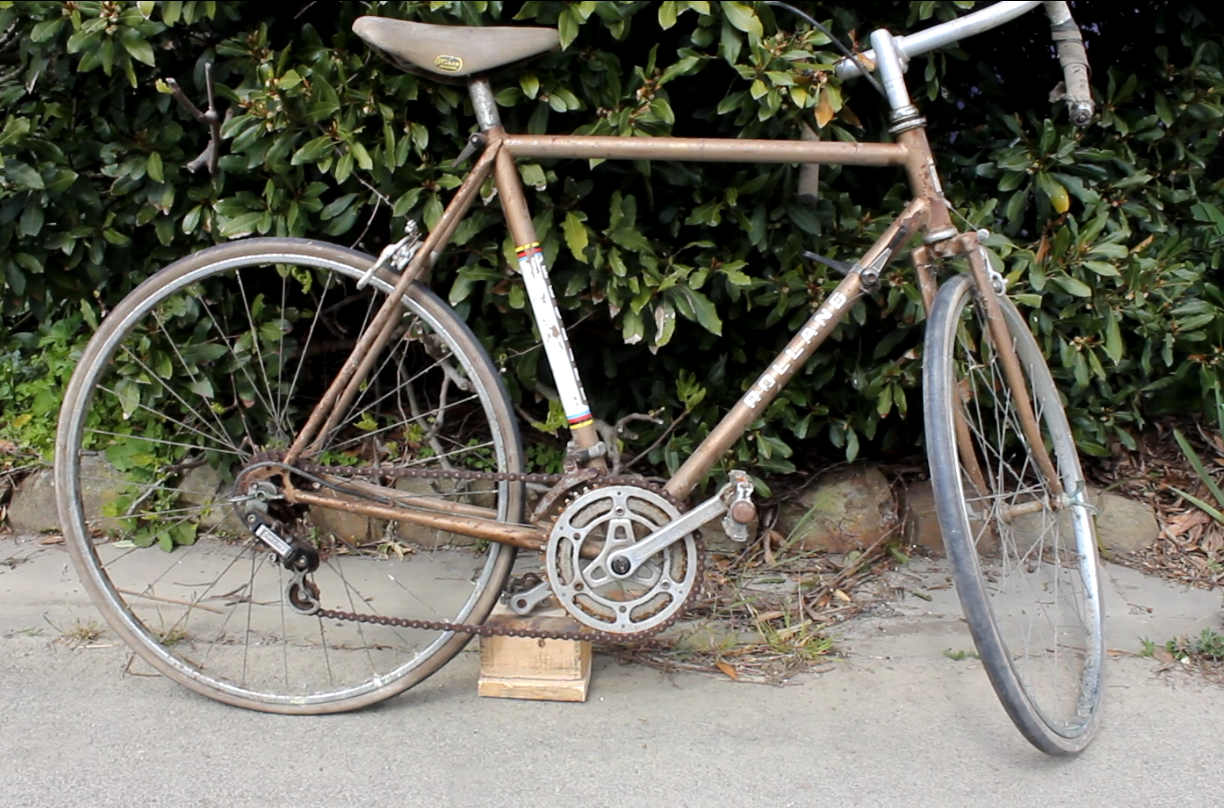
The Bicycle: These wonderful machines are very often discarded long before their useful life has ceased, so can be bought, very cheaply, from secondhand shops, yard sales and many other sources. Alternatively, one can just intercept them before they get thrown into the dumpster. In my case, items like these are 'fly-tipped' behind our village bottle-bank and it is always worth my checking occasionally to see if any have been left there. The one I'm using for this project is from this latter source and is a well-used Rolland (now Jacquot) of Versailles. The major components of this i.e. frame, crankset and rear wheel hub were still O.K. for my needs.
The Washing Machine Drum: An old top-loading model that was badly corroded around the base was given to me by a friend. The drum and drum housing, including the bearings were still serviceable.
The Pallet: A non-standard sized pallet long enough to fit the bicycle and the supported drum was selected. For the layout of my components the pallet size was: 135cm x 80cm (53" x 32").
Extra Materials
Stands - I used the metal ones I had created for a previous pedal-powered washing machine but at the end I'll post a link on how I make wooden ones from untreated pallet wood.
Pallet Wood Planks Various sizes and thicknesses
Nuts, Bolts and Washers to fit:
Threaded bar - with regard to sizes as detailed above, this will need to correspond to the existing threads on the washing machine.
Additional Bicycle Chain - approximately 10" (250mm)
Tools
All of this build can be achieved with hand tools but if you have them and the power to run them, then obviously it will be quicker if you use power tools for some of the build:
taps and dies
spanners
screwdriver
wood saw
hacksaw
vice
angle grinder
electric drill
lathe (optional)
tape measure
The Design
The criteria for making a successful spin-dryer was to be able to increase the drum rotation speed such that the wet contents of the drum would be forced against the drum wall by centrifugal/centripetal force and the water would pass through the perforated drum wall. The faster the spin speed the greater the force and hence the more water should be expressed out of the laundry. In addition, the duration of spin would also affect the water removal.
The position of the drum in relation to the bicycle was also an important consideration: whether the drum is in front of the bicycle or behind makes a difference to the overall pallet size and chain length. I had already found that the smallest footprint would be achieved with the drum in front of the pedals rather than behind.
The washing machine had a direct drive from the crankset to a chainwheel attached to the drum shaft. They were the same size and thus had a 1:1 gear ratio. For the new project I used the smallest gear from the rear wheel gear cluster on the drum shaft which would raise the ratio to 1:3.2. Initially I had thought of having the same 'fixed wheel' arrangement between bicycle and drum as on the washing machine (see above) but after a discussion with some undergrad students on design choices for the spin-dryer I decided to see if it were possible to use a freewheel hub instead.
The Build - The Gearing Cluster
As I mentioned earlier, the exterior housing of the washing machine was not in a sound state, so I removed the drum/pulley wheel assembly from it.
The first part of the build was to obtain the rear wheel cluster and hub from the bicycle. I clamped the wheel by its spindle in the vice and removed the spokes using a cutting disc in the angle grinder. The spokes from the wheel hub on the other side to the gear cluster were the first to be removed, allowing easier access for the cutting disc to those fixed nearest the cluster. Once all removed the last remaining portions of the spokes could be ground out from the rear of the hub.
I then needed the bearing and housing removed
from the remainder of the rear wheel spindle housing. Once again using the cutting disc I removed the other end of the spindle housing which then enabled me to clamp it in the vice and cut the bearing and its housing from the rest with a hacksaw.
The bearing and housing fitted into the gear cluster and a 10mm threaded bar was used instead of the wheel spindle. Matching nuts either side of the cluster held the cluster securely in place.
The problem I was now faced with was, for the bicycle/drum configuration I had opted for, the hub would have to fit into the drum shaft with the smallest gear of the cluster nearest to the drum. This would still let me pedal in the conventional, cycling direction to turn the drum. The drum shaft was threaded at the end to accommodate an 8mm screw so I needed to reduce the threaded spindle from 10mm to 8mm and cut a new thread to fit.
I held the free end of the 10mm shaft in the chuck of my wood-turning lathe and reduced the shaft diameter using the angle grinder whilst the lathe was in motion. I had an 8mm washer as a go/no go gauge, checking the fit frequently to ensure I did not remove too much from the spindle diameter. Once I got my gauge washer to fit down the ground portion, I clamped the 10mm end of the shaft between two pieces of wood in the vice (to prevent damage to the thread), filed a chamfer on the free end of the 8mm section and cut the thread with an 8mm die.
The newly-made shaft could then be screwed into the drum shaft and the gear cluster secured to the 10mm portion of this shaft. A visual check was made to ensure the gear cluster was running concentrically with the drum shaft
The Build - Attaching the Bicycle
It was now time to attach the bicycle and the drum onto the pallet. The bicycle was supported on two axle stands that I had made for our original; pedal-powered washing machine. These were of welded construction. If I had not had these available, I would have made new ones using pallet wood:- see how to make these under Related Articles. The metal supports were fixed to the pallet using wood screws.
The Build - Attaching the Drum
The drum mounting was more difficult. As was explained at the beginning of this post, the housing of the machine was very badly corroded and could not be used. Thus I had to make wooden supports that could in turn be fixed to the pallet. The biggest problem with this was that there was no common datum on the bottom of the drum housing, in effect the drum if placed onto a flat level surface could not stand upright. In order to obtain a level across the three mounting points, I turned the drum over onto its lid, ensuring that the lid opening catch was not touching the workbench surface. The height difference between the mounting points could then be determined and wooden planks and spacers cut to the appropriate length and thickness and attached, using the original mounting bolts and nuts (recuperated). These supports
were in turn screwed to the 'carrier' planks which were parallel to the drum axis, so as to fit across the pallet, next to the bicycle. These two 'carrier' planks were slotted, two slots per plank, the slots coincided with the approximate centre line of planks on the main pallet and with four holes drilled therein. Securing bolts and washers secured the drum to the pallet.
Drainage of water from the drum was as with the pedal washing machine via gravity. I had established that once the redundant pump assembly had been removed from the bottom of the drum, a conventional vacuum cleaner hose would fit neatly over the exit port where the pump had been attached.
At this stage of the construction, I was still unsure as to how much additional bracing would be needed in order to hold the drum steady at the elevated speeds of spinning. As a provisional measure, I took advantage of four moulded stubs integral to the drum housing, these originally held the shock- absorbers. Down the centre of each stub I drilled a hole and then tapped it to 6mm. I then attached planks which spanned the pairs of stubs on each side of the drum housing using 6mm bolts.
Now the drum was fixed to the pallet, I could extend and attach the chain from the bicycle to the smallest gear of the cluster on the drum shaft. It is possible to ensure the chain is running straight between the two sets of gears simply by looking along the faces of the two gear sprockets (driving and driven). Optimum chain tension and alignment was attained by moving the drum assembly on its slotted mounting holes prior to tightening the mounting bolts.
Test Run
Once the bicycle and drum were connected, a quick pedal with the drum empty established that there were no problems with alignment and chain tension. So it was then time for the acid test.
Wet washing was transferred from the washing machine into the spin dryer and the lid closed. The starting load on the pedals was noticeably higher compared to the lower 1:1 gear ratio of the washing machine but it was not difficult to set the drum in motion. Slowly accelerating it became apparent that for what seemed a relatively slow pedal speed, water was exiting rapidly from the drain tube. Accelerating further the water flow increased and then as the contents became drier, diminished. Timing my pedaling speed I determined that the drum spin speed was about 350 rpm which could be maintained for at least a couple of minutes until the water flow was nil. Letting the drum freewheel to a halt, the contents were examined and were definitely much drier, to the extent that no further water could be extracted when it was attempted to wring it by hand.
Here's the film to see it in action:
After using the spin dryer for several months I think we've established that the configuration works really well but the distribution of the wet load within the drum is crucial. Uneven loading results in shaking of the whole machine and pallet and it is often the case when the wet washing comprises just a few items. With a single large item though - Sue washed our feather duvet, the spin dryer was amazing.
Improvements
The first thing that would improve the spin dryer will be to obtain another top loading machine and keep the drum in its original housing. This would obviate the need of making elaborate supports to hold the drum level and steady.
Secondly I think that the drive to the drum should be direct i.e. not freewheel. This I believe will enable the 'cyclist' to rotate the drum in both directions at the start of the spin-cycle to distribute the wet contents evenly within the drum and thus prevent the need to stop spinning to even the load in the drum.
Hope you enjoyed this project and much as we do having non-drip washing! If you read this article and found it interesting then share it with your friends on social media or suchlike. Please also feel free to ask questions and or make comments and if you found this helpful and would like to support this site you can always
You can also find all my films Youtube and also now on Odysee
Until next time and from a sunny day in Normandie,
The following article came about, as did the film, (posted below) because several friends and relatives presented me with non-working stick vacuum cleaners and this one had not only the worse problem but also for which there was no solution on-line. I therefore, thought it would be a good idea to share my solution as this video has become not only one of my most popular recent uploads but also has through the comment section, shown me how many people there are out there encountering similar problems. However, it has to be stressed that with this particular Electrolux Ergorapido, the cleaner had been so badly treated that the damage was serious but could still be fixed. I would just add that I am not a vacuum cleaner specialist but being an engineer am always interested in taking things apart and trying to understand why they work...or in this case...why they don't!
Problem and Initial Deductions
It had already been established that the batteries were OK because when the vacuum cleaner was turned on the three LED tell-tale lights on the Detachable Hand Unit momentarily show
'orange'. However these lights then immediately go out and the single 'red' light above them comes on. This to me is indicative of a
motor experiencing 'overload' due to some mechanical resistance. From my point of view, this is an excellent sign because it signifies that the fault is not electronic and therefore much more likely to be reparable!
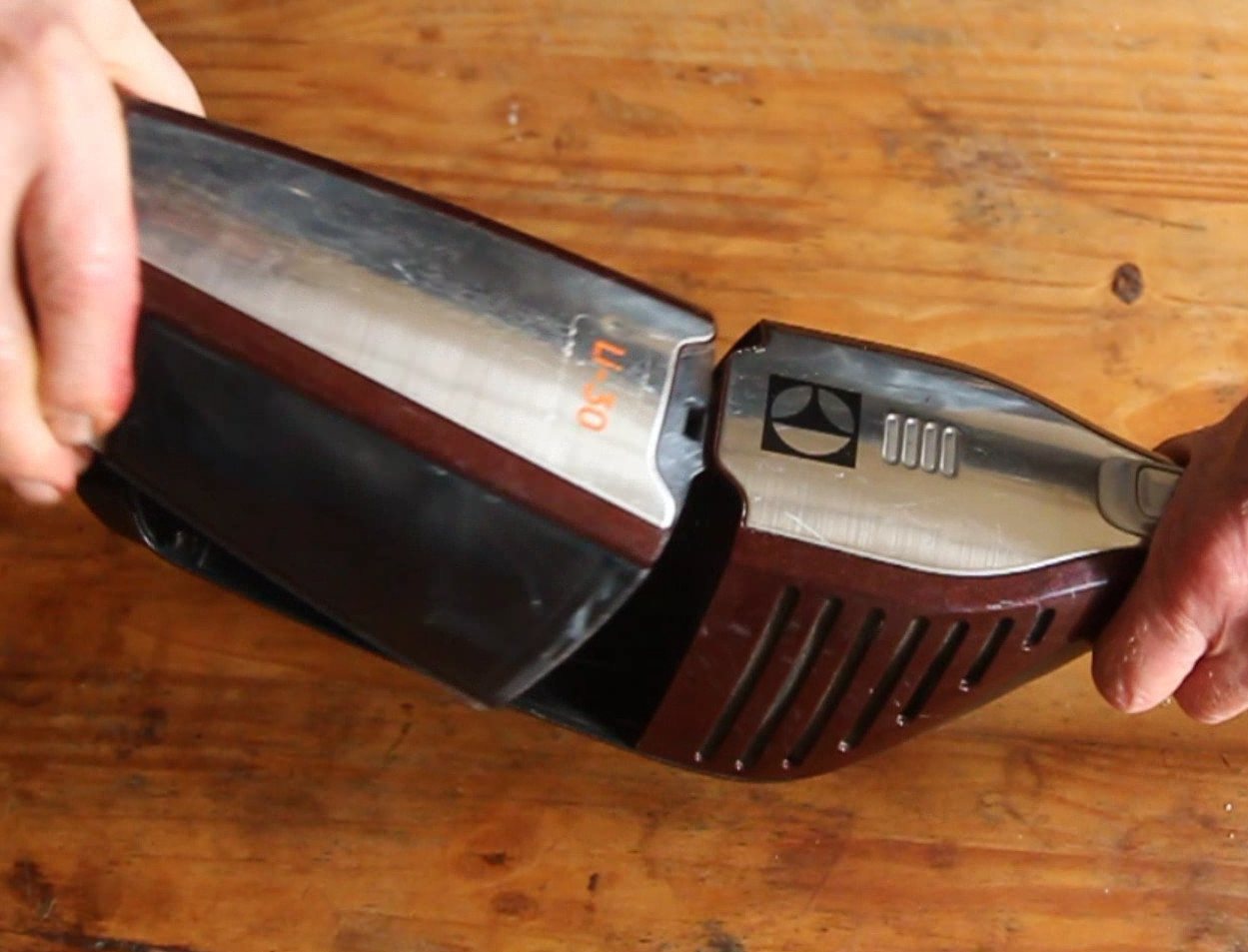
NB By detaching the Hand Unit from the main body of the vacuum cleaner it was obvious that the fault lay in the former not in any of the moving components of the main vacuum cleaner body, such as the sweeping brushes. It is important to establish this, as one of the other main problems with these devices which I have come across both from relatives and through comments on my YouTube channel, is with debris such as cotton thread or similar wrapped around the brushes. This will cause the rotating brushes to seize and indicate an overload in a similar way.
Tools
The Torx bit above has a long shank, this is so that it can access several screws which are deeply recessed. If you are using a conventional Torx screwdriver and not just a handle with Torx bits, then access to these screws should be OK because of the blade length to the handle. Included below is an image to show the bit I had to use.
Taking the Hand Unit Apart
The first item to remove is the Dust Collector, this is done by pressing the two release catches on the side of the unit. Put the Dust Collector to one side.
Turn the Hand Unit over and locate the 5 screws holding the casing in place and remove them with the Torx.
Using the screwdriver blade in the penknife, gently prize open the Case which is held in place with snap connectors along either side.
When you open it, there will probably be a layer of dust. You will need to clean this out before you proceed to the next stage. I used the paint brush for this.
Peel back the Rubber Housing on the front of the Motor to expose the Fan in its plastic housing.
I gently inserted a screw driver into the side of the fan to check that it turned - it did not! Therefore, I deduced that this was the reason why the motor was overloading.
Using the screwdriver remove the two screws holding the Circuit Board in place.
Remove the Rubber Housing from the Fan making sure to remember the orientation for how it fits back together.
Using the paint brush remove as much dust as possible from the fan.
Using the flat bladed screw driver or pen knife gently prize apart the snap connectors that hold the Fan and the Fan Housing together.
Diagnosis & Repair
As you can see on the inside face of the Fan Housing and on the face of the Fan itself the plastic is deeply scored, suggesting some foreign material has collected inside the Fan and actually fused the Fan and its Housing together
Once there is no load on the fan we can now see that the fan turns and the motor engages. There is a little vibration but not much and this may be caused because the scoring to the face has slightly altered the balance of the fan.
Remove as much dust as possible, I used a vacuum cleaner and then a cable tie to clean between the vanes of the fan to remove all the caked on dirt and dust and there was a lot!
It was evident once the Fan and Fan Housing had been fully cleaned that what ever had damaged them had only done this to part of their surfaces. I then used coarse and fine sand paper to smooth down the areas that had been scored.
Reassembly
Check to make sure it is running OK. Reattach the front of the Fan Housing and then reassemble. Do not forget to secure the circuit board prior to attaching the outer cover (because I did!!).
Check again to make sure the vacuum cleaner is running. Prior to putting on the empty dust collector, remember to clean the filters, using the method as recommended in the manual.
Here's the film:
If
you have enjoyed this article and found it interesting then share it
with your friends on social media or suchlike. Please also feel free to
ask questions and or make comments and if you found this helpful and would like to support this site you can always =$3.
Until next time and from a sunny day in Normandie,
Cheers, Andy
Additional Information
I've received a very interesting question in the comments section below and thought I should insert these images of the circuit board.
Underside of circuit board beneath switch (at screwdriver tip)
My cousins found this beautiful vintage
chandelier in a dumpster/skip in Manhattan and carried it all the way
over to us in rural France. It needed TLC and....read more
How to Convert your Washing Machine to Pedal Power 1 - The Basic Model (Front-Loader)
The electronic fault that arose in our automatic washing machine
rendered it useless. I knew that the machine was watertight and...read more
How to Convert your Washing Machine to Pedal Power 2 - Modifications (Front-Loader)
We’ve exhibited this machine on many occasions and the most frequent
comment from spectators has been ‘let’s see you spin dry now!’...read more
Convert Your Washing Machine to Pedal Power Part 1 - Getting Started (Top-Loader)
The
most frequent reasons for machine failure is of an electrical or
electronic nature. Neither of these preclude using it, as long as the
drum is watertight. Even if you don't already own a broken machine I can
guarantee that..read more
Wheelbarrow rebuild using pallet wood
I made a pallet wood replacement for our wheelbarrow and it served its purpose for
about 8-10 years. During the last few months of life, I could see
the inherent mechanical weaknesses in my version and so as the frame and
wheel were still in running order, I determined...read more
Tailgate gas strut fail? Pallet wood car repair solution - 2 Methods
Goods are made from a series of mass-produced 'outsourced' components,...the durability of some is less than the working life
of the whole....read more
Binocular Collimation Quick and Easy Method without Prism Adjustment
I was initially put off from correcting an optical fault in an old pair
of Porro prism binoculars because all I had seen or read online involved
prism adjustment...read more
My cousins found this beautiful vintage chandelier in a dumpster/skip in Manhattan and carried it all the way over to us in rural France. I've only ever seen one other similar light fitting on line, it was on Etsy, where it was described as 'French Farmhouse Style', so it looks like this rooster has come home to his native roost.
The chandelier is made of mild steel and then finished with a verdigris patina. I'm not sure of its age but looking at the sconces and the good quality of the workmanship (witness the down-sweep of the 'cage' meeting the 'perch' and the individual welding of the feathers), I'm guessing 1950's or maybe a later artisanal piece. I deduce this because it appears to have been MIG welded, a process that only started commercially in 1948.
Looking at what we previously had as lighting in the kitchen which was a
'brass-een' mock Georgian chandelier, there was no comparison with this
beautiful vintage piece. All it needed was some TLC and a replacement
of the wiring. In the following I go through step-by-step of how I
accomplished this.
When it first arrived one of the bulb holders and sconces had come adrift so I had to repair that before I could start the re-wirng. The piece that had come apart was a standard steel nut so it was easy to weld it back in place.
I had decided that the whole fitting needed re-wiring and the bulb holders replaced.
Replacement cable of suitable standard was readily available from my local DIY store as were the 5 bulb holders.
Before I commenced the re-wiring I attached the chandelier to a wooden stand base that I had made for the dressmaker's dummy.
The first stage was to to remove the old bulb holders. I detached them from the original wires by unscrewing them from the base of each bulb holder- I did not cut the wires as I was going to need the maximum length of original wire exposed so as to be able to attach the new cable to it for the rewiring process.
At the top of the chandelier was the hanger and short chain for attaching the fitting to a supporting hook. The power supply cable entered the chandelier at this point and comprised of a closed metal cylinder the upper and lower covers on which were removed by unscrewing the hangar.
Inside the cylinder were the connections necessary to divide the incoming power feed into the five pairs of wires going down inside the arms to the bulb holders. An earth wire was attached to the inside of the metal cylinder and this I considered to be suitable to keep as it was perfectly OK when I checked it for continuity with my multimeter.
Rewiring
I had disconnected the wires from their rather crude connectors at the top of the chandelier so that I could see each pair of wires entering the square tube of each descending arm. I had decided that I would use the original wire to act as a 'pull through' for the new cable and planned to attach the new cable to the free ends of the wire at the bulb holder end and pull it through. I had mistakenly believed I could do this without needing to remove the sconces. This I soon discovered was not possible as these sconces were fitted to a threaded steel nipple which was fixed to the nut on the arm. The angle the wire was taking into the arm was extremely acute and it was impossible to pull the new wire through due to this. Thus, I needed to remove each securing nut, sconce and nipple from the arms prior to feeding in the replacement cable. All but one of these nipples were removed with the minimum trouble thanks to my trusty can of 'WD40' but one nipple would not budge and the thread of this one was damaged in the process of removal. Once all these components were unscrewed, the route for the cable was less restricted.
In order to run the new cable through the arms, I exposed the new wires at the end of the cable and twisted them into those of the old wires and taped them together. I could then pull the old wire from the top of the chandelier whilst simultaneously feeding the new cable in up through the arm. I then repeated this with the other four arms.
I now needed to make a new nipple by drilling a hole down the centre of a bolt and cutting it to length.
The new cable was now fed through the nipples, sconces, washers and locking nuts and the bared ends of the new wires attached to the bulb holders, which were then screwed in place.
At the top of the chandelier, I cut the wires to length and connected these to the connecting blocks. I then fed the new supply cable through the hangar and the lid of the cylinder and attached it to the other side of the connecting blocks. After this was done, I closed the top of the housing and tightened the suspension/hanging ring.
I attached a plug to the power feed wire and fitted the bulbs in place so I could check connections. After that was done I was ready for the lighting ceremony and the chandelier was fitted into place and wired into the house lighting circuit.
Here's the film:
If you would like to join me on Odysee then please do so through this link and I will get a bonus and you shold get some crypto too! Odysee - Organikmechanic
Fiat lux!
If
you have enjoyed this article and found it interesting then share it
with your friends on social media or suchlike. Please also feel free to
ask questions and or make comments and if you found this helpful and would like to support this site you can always =$3.
Until next time and from a sunny day in Normandie,
I made a pallet wood replacement for our wheelbarrow and it served its purpose for
about 8-10 years. During the last few months of life, I could see
the inherent mechanical weaknesses in my version and so as the frame and
wheel were still in running order, I determined...read more
Pallet Wood Dress Form & Display Dummy. Part 1
Sue is making costumes for Climb the Ivy Films in Scotland, with no
possibility for fittings. Our pallet wood dress form can be adjusted for
men women and children...read more
Pallet Wood Dress Form & Display Dummy Part 2
Stretching a tee shirt over the form and/or padding it out with fabric
the finished mannequin also makes a great display stand for yard sales,
craft fairs or
for photographing items for sale on etsy or ebay...read moremore
Home-made Studio Lights from Recuperated Materials
Anyone who takes photos or makes videos especially indoors realises the
importance of good lighting.
Some years ago I made a floodlight using a bright, low energy bulb
fitted into a reflector-lined bowl. The bowl was a plastic garden
planter and the whole thing cost me next to nothing to make...read more
LED Telescope Tripod Lights from Scrap
There is nothing so sorry looking as a garland of Fairy lights with some
of the bulbs diminished or dead. You feel you can't throw them away as
some of the lamps are burning bravely... The lights here are
battery powered LEDs, which make them ideal for upcycling to tripod
lights, as they have both the required battery pack and switch....read more